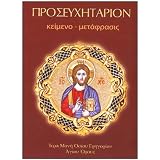
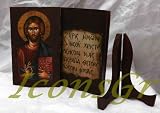
Iconsgr Book
- Wooden Greek Orthodox Icon Book style with display of Jesus Christ
- WIDTH: 29 CM OR 11.4 IN LENGTH: 20 CM OR 7.9 IN
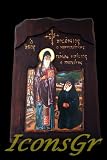
- Wooden Greek Orthodox Icon of Saint Arsenios / Elder Paisios
- WIDTH: 30 CM 11.81 in LENGTH: 20 CM 7.87 in
- Arsenios: St. Arsenios the Cappadocian (1840-1924) was the spiritual father of Elder Paisios' family. He baptized Elder Paisios as an infant. Throughout his life Elder Paisios had great love and reverence for the memory of St. Arsenios, and it was out of this love that he compiled the book "Saint Arsenios the Cappadocian" which provides us with the details of his life. St. Arsenios pastored his Greek Orthodox flock amidst extremely difficult conditions. He lived with his people in the village of Farasa in Cappadocia, which after 1453 had fallen into the hands of the Muslim Turks. Under the harsh yoke of the Turks, the Greek people of Farasa formed an oasis of Orthodox Christianity. They sought refuge in holy St. Arsenios, who was their teacher, their spiritual father, and the healer of their souls and bodies. His reputation as a healer was so great that not only Greek Christians but also Turkish Muslims came to him for healing. Many times his village was threatened with violence from marauding Turks, but each time it was preserved in a miraculous way by St. Arsenios. The accounts in this book, which were taken down by Elder Paisios from eyewitnesses, testify to how powerfully God works through His holy ones, and to how lovingly He cares for and protects His children amidst adversity. Since 1970, many apparitions and miracles have occurred near his holy relics, which reside in the Monastery of Souroti near Thessalonica. He was officially glorified by the Patriarchate of Constantinople in 1986.
- Paisios: Elder Paisios of Mount Athos (Greek: Γέροντας Παΐσιος ο Αγιορείτης), born Arsenios Eznepidis (1924-1994), was a well-known Eastern Orthodox monk from Farasa, Cappadocia. He is famous for his spiritual teachings. Many people worldwide, especially in Greece and in Russia, highly venerate Elder Paisios and anticipate his formal canonization as a saint in the near future. On 25 July 1924, Arsenios Eznepidis was born in Farasa, Cappadocia, shortly before the population exchange between Greece and Turkey. Arsenios' name was given to him by St Arsenios the Cappadocian, who baptised him, named the child for himself and foretold Arsenios' monastic future. After the exchange, the Eznepidis family settled in Konitsa, Epirus. Arsenios grew up here, and after intermediate public school, he learned carpentry. During the civil war in Greece, Arsenios served as a radio operator. In 1950, this was accomplished, and he went to Mt Athos: first to Fr Kyril, the future abbot of Koutloumousiou monastery, and then to Esphigmenou Monastery (although he was not supportive of their later opposition to the Ecumenical Patriarchate). Arsenios, having been a novice for four years, was tonsured a monk and was given the name Averkios. Soon after, Fr Averkios went to the (then) idiorrhythmic brotherhood of Philotheou monastery, where his uncle was a monk. While there, he was in obedience to Elder Symeon. In 1956, Elder Symeon was to tonsure Fr Averkios to the small schema, giving him the name Paisios.
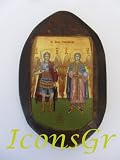
- Wooden Greek Orthodox Icon of Archangels Michael And Gabriel
- WIDTH: 8 CM OR 3.1 IN LENGTH: 14 CM OR 5.5 IN
- Gabriel: In Abrahamic religions, Gabriel (Hebrew: גַּבְרִיאֵל, Modern Gavri'el Tiberian Gaḇrîʼēl, God is my strength; Arabic: جبريل, Jibrīl or جبرائيل Jibrāʾīl) is an angel who typically serves as a messenger sent from God to certain people. In the Bible, Gabriel is mentioned in both the Old and New Testament. In the Old Testament, he appeared to the prophet Daniel, delivering explanations of Daniel's visions (Daniel 8:15-26, 9:21-27). In the Gospel of Luke, Gabriel appeared to Zecharias, and to the virgin Mary foretelling the births of John the Baptist and Jesus, respectively (Luke 1:11-38). Gabriel is not called an archangel in the Bible, but is so called in Intertestamental period sources like the Book of Enoch. In the Roman Catholic, Anglican, Lutheran, Eastern and Oriental Orthodox churches, the archangels Michael, Raphael, and Gabriel are also referred to as saints.
- Michael: Michael ("who is like God?", Hebrew: מִיכָאֵל (pronounced [mixåˈʔel]), Micha'el or Mîkhā'ēl; Greek: Μιχαήλ, Mikhaḗl; Latin: Michael (in the Vulgate Michahel); Arabic: ميخائيل, Mīkhā'īl) is an archangel in Jewish, Christian, and Islamic teachings. Roman Catholics, the Eastern Orthodox, Anglicans, and Lutherans refer to him as "Saint Michael the Archangel" and also as "Saint Michael". Orthodox Christians refer to him as the "Taxiarch Archangel Michael" or simply "Archangel Michael". Michael is mentioned three times in the Book of Daniel, once as a "great prince who stands up for the children of your people". The idea that Michael was the advocate of the Jews became so prevalent that in spite of the rabbinical prohibition against appealing to angels as intermediaries between God and his people, Michael came to occupy a certain place in the Jewish liturgy. In the New Testament Michael leads God's armies against Satan's forces in the Book of Revelation, where during the war in heaven he defeats Satan. In the Epistle of Jude Michael is specifically referred to as "the archangel Michael". Christian sanctuaries to Michael appeared in the 4th century, when he was first seen as a healing angel, and then over time as a protector and the leader of the army of God against the forces of evil. By the 6th century, devotions to Archangel Michael were widespread both in the Eastern and Western Churches.
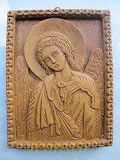
- HANDMADE CARVED AROMATIC ICON BLESSED FROM MOUNT ATHOS OF ARCHANGEL GABRIEL
- WIDTH: 12 CM OR 4.7 IN LENGTH: 17 CM OR 6.7 IN
- This is a handcrafted icon of Archangel Gabriel made solely from three 100% natural ingredients. Pure bees wax and incense from Mount Athos and mastic from Chios Island. It is carved by hand and emits a distinct aroma of its ingredients, which takes you to a monastic atmosphere. This should only to be placed away from sunlight and extreme heat over 50 oC
- Handmade
- Gabriel In Abrahamic religions, Gabriel (Hebrew: גַּבְרִיאֵל, Modern Gavri'el Tiberian Gaḇrîʼēl, God is my strength; Arabic: جبريل, Jibrīl or جبرائيل Jibrāʾīl) is an angel who typically serves as a messenger sent from God to certain people. In the Bible, Gabriel is mentioned in both the Old and New Testament. In the Old Testament, he appeared to the prophet Daniel, delivering explanations of Daniel's visions (Daniel 8:15-26, 9:21-27). In the Gospel of Luke, Gabriel appeared to Zecharias, and to the virgin Mary foretelling the births of John the Baptist and Jesus, respectively (Luke 1:11-38). Gabriel is not called an archangel in the Bible, but is so called in Intertestamental period sources like the Book of Enoch. In the Roman Catholic, Anglican, Lutheran, Eastern and Oriental Orthodox churches, the archangels Michael, Raphael, and Gabriel are also referred to as saints.
- Handmade icon of Archangel Michael
- WIDTH: 14 CM 5.51 in LENGTH: 37 CM 14.56 inOrthodox Greek icon
- Michael ("who is like God?", Hebrew: מִיכָאֵל (pronounced [mixåˈʔel]), Micha'el or Mîkhā'ēl; Greek: Μιχαήλ, Mikhaḗl; Latin: Michael (in the Vulgate Michahel); Arabic: ميخائيل, Mīkhā'īl) is an archangel in Jewish, Christian, and Islamic teachings. Roman Catholics, the Eastern Orthodox, Anglicans, and Lutherans refer to him as "Saint Michael the Archangel" and also as "Saint Michael". Orthodox Christians refer to him as the "Taxiarch Archangel Michael" or simply "Archangel Michael". Michael is mentioned three times in the Book of Daniel, once as a "great prince who stands up for the children of your people". The idea that Michael was the advocate of the Jews became so prevalent that in spite of the rabbinical prohibition against appealing to angels as intermediaries between God and his people, Michael came to occupy a certain place in the Jewish liturgy. In the New Testament Michael leads God's armies against Satan's forces in the Book of Revelation, where during the war in heaven he defeats Satan. In the Epistle of Jude Michael is specifically referred to as "the archangel Michael". Christian sanctuaries to Michael appeared in the 4th century, when he was first seen as a healing angel, and then over time as a protector and the leader of the army of God against the forces of evil. By the 6th century, devotions to Archangel Michael were widespread both in the Eastern and Western Churches.
- Wooden Greek Orthodox Wood Icon of Saint Arsenios / Saint Elder Paisios
- WIDTH: 30 CM 11.81 in LENGTH: 20 CM 7.87 in
- Arsenios: St. Arsenios the Cappadocian (1840-1924) was the spiritual father of Elder Paisios' family. He baptized Elder Paisios as an infant. Throughout his life Elder Paisios had great love and reverence for the memory of St. Arsenios, and it was out of this love that he compiled the book "Saint Arsenios the Cappadocian" which provides us with the details of his life. St. Arsenios pastored his Greek Orthodox flock amidst extremely difficult conditions. He lived with his people in the village of Farasa in Cappadocia, which after 1453 had fallen into the hands of the Muslim Turks. Under the harsh yoke of the Turks, the Greek people of Farasa formed an oasis of Orthodox Christianity. They sought refuge in holy St. Arsenios, who was their teacher, their spiritual father, and the healer of their souls and bodies. His reputation as a healer was so great that not only Greek Christians but also Turkish Muslims came to him for healing. Many times his village was threatened with violence from marauding Turks, but each time it was preserved in a miraculous way by St. Arsenios. The accounts in this book, which were taken down by Elder Paisios from eyewitnesses, testify to how powerfully God works through His holy ones, and to how lovingly He cares for and protects His children amidst adversity. Since 1970, many apparitions and miracles have occurred near his holy relics, which reside in the Monastery of Souroti near Thessalonica. He was officially glorified by the Patriarchate of Constantinople in 1986.
- Paisios: Elder Paisios of Mount Athos (Greek: Γέροντας Παΐσιος ο Αγιορείτης), born Arsenios Eznepidis (1924-1994), was a well-known Eastern Orthodox monk from Farasa, Cappadocia. He is famous for his spiritual teachings. Many people worldwide, especially in Greece and in Russia, highly venerate Elder Paisios and anticipate his formal canonization as a saint in the near future. On 25 July 1924, Arsenios Eznepidis was born in Farasa, Cappadocia, shortly before the population exchange between Greece and Turkey. Arsenios' name was given to him by St Arsenios the Cappadocian, who baptised him, named the child for himself and foretold Arsenios' monastic future. After the exchange, the Eznepidis family settled in Konitsa, Epirus. Arsenios grew up here, and after intermediate public school, he learned carpentry. During the civil war in Greece, Arsenios served as a radio operator. In 1950, this was accomplished, and he went to Mt Athos: first to Fr Kyril, the future abbot of Koutloumousiou monastery, and then to Esphigmenou Monastery (although he was not supportive of their later opposition to the Ecumenical Patriarchate). Arsenios, having been a novice for four years, was tonsured a monk and was given the name Averkios. Soon after, Fr Averkios went to the (then) idiorrhythmic brotherhood of Philotheou monastery, where his uncle was a monk. While there, he was in obedience to Elder Symeon. In 1956, Elder Symeon was to tonsure Fr Averkios to the small schema, giving him the name Paisios.
- Wooden Greek Orthodox Wood Icon of Saint Arsenios / Saint Elder Paisios Big
- WIDTH: 38 CM 14.96 in LENGTH: 25 CM 9.84 in
- Arsenios: St. Arsenios the Cappadocian (1840-1924) was the spiritual father of Elder Paisios' family. He baptized Elder Paisios as an infant. Throughout his life Elder Paisios had great love and reverence for the memory of St. Arsenios, and it was out of this love that he compiled the book "Saint Arsenios the Cappadocian" which provides us with the details of his life. St. Arsenios pastored his Greek Orthodox flock amidst extremely difficult conditions. He lived with his people in the village of Farasa in Cappadocia, which after 1453 had fallen into the hands of the Muslim Turks. Under the harsh yoke of the Turks, the Greek people of Farasa formed an oasis of Orthodox Christianity. They sought refuge in holy St. Arsenios, who was their teacher, their spiritual father, and the healer of their souls and bodies. His reputation as a healer was so great that not only Greek Christians but also Turkish Muslims came to him for healing. Many times his village was threatened with violence from marauding Turks, but each time it was preserved in a miraculous way by St. Arsenios. The accounts in this book, which were taken down by Elder Paisios from eyewitnesses, testify to how powerfully God works through His holy ones, and to how lovingly He cares for and protects His children amidst adversity. Since 1970, many apparitions and miracles have occurred near his holy relics, which reside in the Monastery of Souroti near Thessalonica. He was officially glorified by the Patriarchate of Constantinople in 1986.
- Paisios: Elder Paisios of Mount Athos (Greek: Γέροντας Παΐσιος ο Αγιορείτης), born Arsenios Eznepidis (1924-1994), was a well-known Eastern Orthodox monk from Farasa, Cappadocia. He is famous for his spiritual teachings. Many people worldwide, especially in Greece and in Russia, highly venerate Elder Paisios and anticipate his formal canonization as a saint in the near future. On 25 July 1924, Arsenios Eznepidis was born in Farasa, Cappadocia, shortly before the population exchange between Greece and Turkey. Arsenios' name was given to him by St Arsenios the Cappadocian, who baptised him, named the child for himself and foretold Arsenios' monastic future. After the exchange, the Eznepidis family settled in Konitsa, Epirus. Arsenios grew up here, and after intermediate public school, he learned carpentry. During the civil war in Greece, Arsenios served as a radio operator. In 1950, this was accomplished, and he went to Mt Athos: first to Fr Kyril, the future abbot of Koutloumousiou monastery, and then to Esphigmenou Monastery (although he was not supportive of their later opposition to the Ecumenical Patriarchate). Arsenios, having been a novice for four years, was tonsured a monk and was given the name Averkios. Soon after, Fr Averkios went to the (then) idiorrhythmic brotherhood of Philotheou monastery, where his uncle was a monk. While there, he was in obedience to Elder Symeon. In 1956, Elder Symeon was to tonsure Fr Averkios to the small schema, giving him the name Paisios.
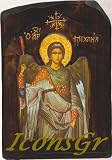
- Wooden Greek Orthodox Icon of Archangel Michael
- WIDTH: 28 CM OR 11 IN LENGTH: 52 CM OR 20.5 IN
- Michael ("who is like God?", Hebrew: מִיכָאֵל (pronounced [mixåˈʔel]), Micha'el or Mîkhā'ēl; Greek: Μιχαήλ, Mikhaḗl; Latin: Michael (in the Vulgate Michahel); Arabic: ميخائيل, Mīkhā'īl) is an archangel in Jewish, Christian, and Islamic teachings. Roman Catholics, the Eastern Orthodox, Anglicans, and Lutherans refer to him as "Saint Michael the Archangel" and also as "Saint Michael". Orthodox Christians refer to him as the "Taxiarch Archangel Michael" or simply "Archangel Michael". Michael is mentioned three times in the Book of Daniel, once as a "great prince who stands up for the children of your people". The idea that Michael was the advocate of the Jews became so prevalent that in spite of the rabbinical prohibition against appealing to angels as intermediaries between God and his people, Michael came to occupy a certain place in the Jewish liturgy. In the New Testament Michael leads God's armies against Satan's forces in the Book of Revelation, where during the war in heaven he defeats Satan. In the Epistle of Jude Michael is specifically referred to as "the archangel Michael". Christian sanctuaries to Michael appeared in the 4th century, when he was first seen as a healing angel, and then over time as a protector and the leader of the army of God against the forces of evil. By the 6th century, devotions to Archangel Michael were widespread both in the Eastern and Western Churches.